1534 Oath of Succession
The King's CurseThe 1534 Oath of Succession was a state-administered test of allegiance that joined a disputed royal marriage to the succession and the king’s claim to govern the Church. At Westminster Palace, Margaret Pole signed an oath she believed to be false, choosing apparent loyalty and the hope of safer days over an open refusal. The same ceremony exposed the limits of that compromise: John Fisher and Thomas More would not sign the text as presented, each holding to a different expression of conscience.
Causes and Stakes
The oath emerged from a struggle over who could determine the validity of Henry VIII’s marriage to Katherine of Aragon and the consequences for the royal succession. Henry’s position was that his first marriage was invalid, his second marriage valid, and Elizabeth I his only heir; Princess Mary Tudor was thereby denied her place as a legitimate princess and successor. The oath made those disputed claims matters of public allegiance rather than leaving them as arguments about the royal marriage.
The conflict had also become a dispute over church authority. Before the oath was administered, Margaret’s son Montague told Princess Mary Tudor that the Church had surrendered to the king: Henry would rule it himself, and the Pope’s authority in England would be set aside. Thomas More had resigned as Lord Chancellor and returned the great seal. Mary recognized the breadth of the change, understanding that the king’s claim reached the Church’s wealth, laws, and courts as well as its government. The oath would require the nobility to affirm this new arrangement alongside the king’s account of his marriages and heirs.
There remained a competing judgment from the Pope. He had publicly ruled that the marriage of Henry VIII and Katherine of Aragon was valid and that Henry should live with her as his wife. Yet, as Margaret understood the situation, the Pope had not excommunicated the king, and the nobles were left to decide what they themselves would do. Papal judgment, royal command, and individual conscience did not resolve into a single uncontested authority; the oath forced people to act amid that conflict.
The Ceremony at Westminster
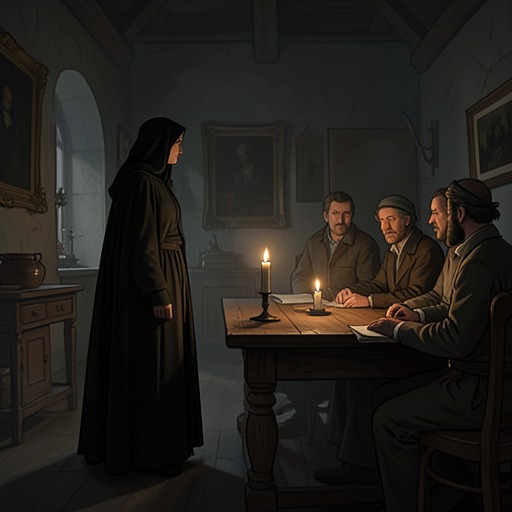
In spring 1534, Margaret was summoned with the other peers to the Privy Council at Westminster Palace. Thomas Cromwell, newly Lord Chancellor after Thomas More, administered the oath to the assembled nobility. The peers approached a great table on which the text lay beneath the great seal. The setting gave the act the weight of a formal public procedure: each person was to place a name beneath claims that touched the crown, the Church, and the identity of the royal heirs.
Margaret’s account makes the ceremony both collective and intensely personal. She knew the Pope had ruled against the king’s position, but also that Henry denied the Pope’s authority in England and claimed the power to define the matter himself. Faced with the written oath, she considered whether she might avoid signing by fainting and being carried away. She was sixty, felt too frail for the decision, and wished she could escape the moment without choosing either open defiance or assent.
She looked up and saw Montague watching her steadily. He would sign, and Geoffrey Pole would follow him. Margaret, Montague, and Geoffrey had agreed to sign so that their loyalty could not be doubted, while hoping for better days. She took up the pen and wrote her name as Margaret, Countess of Salisbury. By doing so, she renewed her allegiance to Henry, pledged loyalty to the children of his marriage to the woman who called herself queen, and acknowledged him as head of the Church in England.
Assent, Conscience, and Refusal
For Margaret, signing did not settle the disputed facts or persuade her that the oath was true. She regarded its claims as lies and understood her signature as making her a liar. After stepping back from the table, she no longer wished she had escaped by pretending to faint; she wished she had possessed the courage to refuse. Her signature therefore carried two meanings at once: an outward performance of allegiance and an inward recognition that she had acted against her own judgment.
The accounts of refusal sharpen that contrast. John Fisher, an elderly bishop and confessor to two queens, was brought from the Tower of London and presented with the oath. He read it repeatedly, then said he did not think he could deny the Pope’s authority. He was returned to the Tower. People disputed whether a bishop could be executed, while some feared that Fisher himself might face execution; Margaret records saying nothing in response. His refusal made explicit the authority that the royal oath sought to displace.
Thomas More also refused the oath in its existing form. He was willing to sign a rewritten version because he did not disagree with much of its wording, but he would not sign the text exactly as it stood. He also declined to condemn either those who drafted the oath or those who signed it, presenting his refusal as a matter of his own soul. His distinction between the propositions he could accept and the required wording made the ceremony’s demand especially clear: it required not merely general loyalty, but assent in a prescribed form.
Margaret remembered that Henry had promised his friend More he would never put him to this test. In her telling, the promise did not protect More once the king’s policy demanded the oath. The episode thus connected the public test of the nobility with a private breach of trust, and set personal allegiance to Henry against obligations that could not be made to disappear by royal command.
Aftermath and Significance
After the ceremony, Margaret returned to Bisham Manor, while Geoffrey went to Lordington. The separation did not remove the burden of her choice: she remained glad to be away from London, where Fisher and More were held in the Tower of London, but continued to regard her own signature as cowardly. Her response shows that compliance preserved a public appearance of loyalty without ending her private opposition to the claims she had endorsed.
The oath’s consequences in the narrative therefore extend beyond the names written at the table. It converted a dispute over marriage and succession into a test of political obedience, while making the king’s authority over the Church part of the same required profession. Margaret’s signature, Fisher’s refusal, and More’s proposed revision display three different responses to that demand: submission despite disbelief, refusal grounded in papal authority, and refusal of the prescribed wording on grounds of conscience. The ceremony’s force lies in this separation between what subjects were required to affirm and what they continued to believe.